
Feline Breast Cancer & Think Pink Giveaways

Updated: These giveaways have closed. We’ve done fab Think Pink giveaways all month in honor of Breast Cancer Awareness.
While Breast Cancer Awareness Month is largely in support of women, cats can contract breast cancer. Dr. Letrisa Miller, a veterinarian with a feline exclusive practice shares what every pet parent needs to know about feline breast cancer.
Cats Get Breast Cancer Too by Letrisa Miller DVM
Do you check your cat monthly for lumps and bumps? All of the talk about Breast Cancer Awareness Month reminded me that many people aren’t aware of feline breast cancer or that one of the best ways to defeat it is the same for both cats and people. The monthly lump check is important not just for you but for your cat too!
Breast cancer is not the most common cancer in cats (I see it two to five times a year), and it is often a tragic diagnosis because it isn’t diagnosed early enough to be treated effectively. Because of this, knowing what to watch for is important. Early detection is the key to early diagnosis and a good outcome.
Breast cancer is most common in middle age to older female cats but does occur in younger cats and rarely in male cats. The most common signalment is an unspayed female of 10 to 12 years old. Siamese cats suffer from breast cancer more than other breeds and have a tendency to get it at a younger age (average nine years old).
A cat’s biggest risk factor for getting breast cancer is being an un-neutered or late neutered female. If a cat is spayed by the age of six months, her chance of getting breast cancer is reduced by a whopping 91%!
The second most significant risk factor is a history of progestin hormone use. The drug Oviban, which was once commonly used for behavior problems and sometimes for itchy skin, is considered to be the most problematic of this class of drug. In general, most veterinarians now consider it to be a drug of last resort in cats (if they will use it at all).
The best way to prevent feline breast cancer is to have your cat neutered by the time she is six months old and not use progestin hormones.
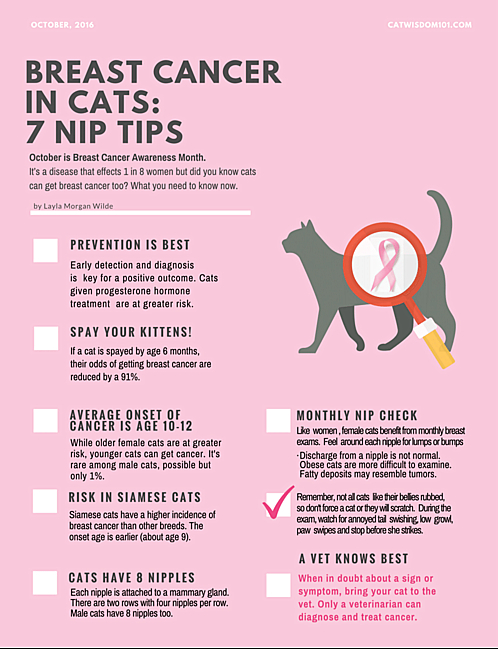
- Cats usually have eight mammary glands, four on each side, on their bellies. The glands have lymph connections. Thus, even if a tumor is confined to one gland, we often see it spread to one or more of the other glands.
- Lumps or masses anywhere in any of the mammary glands have a 90% chance of being cancerous (malignant). Lumps are usually, but not always, found near one of the nipples on the cat’s belly and are usually firm and/or fluid filled.
- Discharge from a nipple is a sign your cat should see the vet ASAP!
- Check your cat’s breast area (and everywhere else too) at least once a month. Just run your hands around your cat, rolling the skin between your fingers to feel for thickened spots or lumps. This can be challenging on obese cats. Also, be aware that many cats have perfectly normal fat “pads” in the groin area.
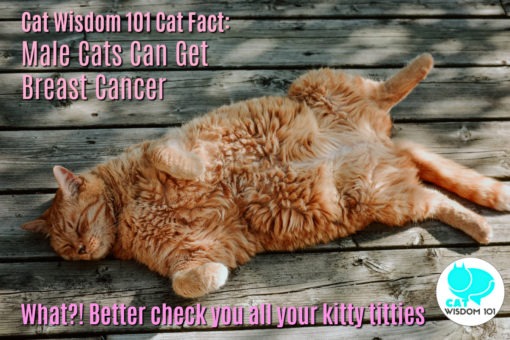
If you’re not certain, ask your veterinarian about what is normal and what isn’t when you first start doing lump checks. Don’t be embarrassed about asking for help! Asking may save your cat’s life, and none of us was born knowing normal cat anatomy.

Veterinarians see several types of breast cancer in cats. Mammary carcinoma and adenocarcinoma are the most common, but all types tend to be aggressive, meaning that they grow and spread quickly. Often they spread early in the course of the disease. The amount of lymph drainage in the breast and the fact that these tumors like to spread through the lymph system aids their progression.
Breast cancer usually spreads to the lungs and to adjacent mammary glands or lymph nodes. Tumors tend to grow quickly, soon outgrowing their blood supply. When this happens, the center of the tumor dies and starts to rot (necrosis). The tumors also tend to cause the overlying skin to die, quickly leading to open “rotting” sores.

Tumors in long-haired cats are often not noticed by caretakers until they reach this stage. I have seen tumors reach this stage in as little as two or three weeks, so I advise having any lump in the breast area of a cat seen by a veterinarian within a few days of discovery. The sooner the tumor is addressed, the better your cat’s chances for survival.
When a client finds a mass in the breast area of his or her cat, I examine both the cat and the lump. If the cat is healthy enough for surgery, I biopsy the lump to determine if it is, in fact, breast cancer. Some veterinarians do needle aspirates of lumps, but these are often not diagnostic and may delay diagnosis and treatment.
Because only around 10% of lumps in this area are noncancerous, many veterinarians and veterinary oncologists recommend immediate excisional biopsy. This means taking out the whole lump to send to the pathologist for diagnosis. If the veterinarian is reasonably certain of the diagnosis before surgery, the entire lump with at least two centimeters of normal-appearing tissue around the lump should be removed and submitted for biopsy, possibly with the lymph node that drains the region.
This is a large amount of tissue but gives the best chance of removing all of the affected tissue and also gives the histopathologist a good sample to examine for invasion of the lymph vessels with cancerous cells.
If the diagnosis is cancer, more surgery is needed because the best chance for long-term survival is to remove all breast tissue to prevent development of new tumors. For this reason (and to reduce the number of surgeries the cat must go through) removing all of the breast tissue on the affected side at the time of biopsy may be the best way to decrease the risk of spread. A second mastectomy to remove the breast tissue from the other side would then be done after the cat has healed from the first surgery (by which point the diagnosis should also be confirmed).
To determine how long a cat will live with breast cancer, we look at the size of the tumor when it is removed and whether the cancer has spread to the lymph vessels. If a tumor is removed before it is bigger than a pencil eraser and no cancerous cells are found in the lymph vessels around the tumor, the cat has a good chance of long-term survival as long as full mastectomy and chemotherapy are done.
Because survival times for cats with larger tumors, particularly tumors that have spread to the lungs, are only one or two months, hospice care is usually offered in lieu of treatment for these patients. For cats that are in between the best- and worst-case scenarios, deciding which course to take can be very difficult. Each cancer patient is an individual, and predicting outcomes can be difficult. Options must be weighed carefully, and all of the available information should be considered when deciding how to proceed.
Veterinary oncologists are a tremendous resource when you and your veterinarian must make decisions in the face of uncertain outcomes. Oncologists are likely to have the most experience and the latest information on treatment protocols and outcomes (especially if you cat has one of the less common types of breast cancer).
Remember that no decision is a wrong one when you are faced with the challenge of a diagnosis of cancer.
Prevention of breast cancer is easy: Spay your kittens! Diagnosis of those unfortunate enough to get this disease rests in large part on frequent examinations. Early detection is the key to survival; however, treatment helps in almost all cases except the most advanced. Breast cancer is a difficult disease and can be devastating, but we are making inroads in detection and treatment.
My best wishes to all of you and your furry children. I hope none of you ever have to face breast cancer, but know that if you do there are many veterinarians who will do their best to help you and your cat and that if the disease is discovered and treated early there is hope.
Letrisa Connecticut Feline Surgery
Think Pink Giveaways
To win our Pink Kritter Kondo valued at $175.00 Just leave a comment at the post here The winner will be announced tomorrow!
Enter to win a Cali Cuv Designer litter box cover here. The winner will be announced on Saturday.
Last chance to enter to win a pair of deluxe Classy Cat Dishes here. The winner will be announced on Saturday. Good luck cat lovers!



23 Comments
Cailary
I have a question. My 10 years old cat haves breast cancer, the vet said it’s in the final state cus we discovered it to late, the bump is really big. I wanted to to the surgery but he said if we do the surgery she will live 6 months more cus the chemotherapy can really kill her since its dangerous. The bump is tied to her belly muscle and its really strong. I have a huge fight with myself now….cus if i convince myself to make him do the surgery my cat will survive 6 months but if i let her like this my vet said she will survive more but in the end she will still die…..I really don’t know what to do! I don’t want my cat to die! I can already see she doesnt eat as much as she did before and she started loosing more fur. I don’t want my cat to die but in the same time i don’t want to torture her with some surgery and therapy that may not save her…..Please give me some advice ……
Nicole
Cailary, I’m sorry you are going through this. I’m not a veterinary professional, I can just relay my own experience with my 12 year old Siamese. I found a tumor on her, and did as was recommended and had the tumor surgically removed. It was two really difficult weeks, and at this point it has been about 6 weeks, her incision was just beginning to heal and now has new tumor growth at either end. Healing means new cell growth, and in my cats case the cancer was/is in her lymph nodes so surgery means the cancer actually spread more/quicker. I did not know at the time of surgery what type of tumor or how aggressive it would be. If I had known, I would not have put her through that, it really did take a lot out of her. We all have to accept our pets are only with us so long and keep them comfortable, and also make decisions for them, not for ourselves. Not easy to do. Its pretty awful reading about tumor ulceration…but in my case the cancer is so aggressive I’m unwilling to make my cat go to vets and be on hardcore medication.
Hailey Suits
Only a few months ago we had to take my cat in to have a mastectomy. We didn’t even notice a lump because his belly hair is rather long even though he is a shorthaired cat (he’s a mutt between a long down generation savannah and a tabby).
The lump had ruptured and turned necrotic, and we tried to keep it clean until I could pull some money together to take him to the vet and have something done. We didn’t even get half the amount necessary, but I was lucky enough that I had gone to a vet with a big heart, and the fact I was bawling my eyes out the whole time probably didn’t hurt either. He couldn’t take the money loss to have it tested, but he removed all the affected tissue and the lymph node, which easily should’ve cost two to three times more than we paid.
My little Tigger was a trooper and came home the same day, a bit drugged and eager to stay as close to momma (me) as possible, going to far as to sleep in the middle of my chest the whole night (almost killing me with fur smotherings.)
Because it had infected the nipple and the conjoining node, they are positive it was breast cancer, but it hasn’t resurfaced in any of his other breast cancer, for which I am so grateful. I’ve had him since before he could open his eyes because he was the runt of a very large litter and I had to bottle feed him before his eyes had even opened.
Ironically, he is now longer than a standing kitchen garbage can and can comfortably put his front paws on our kitchen counter, so one could hardly call him a runt. He enjoys giving me “cheek kisses” (a little nip on the cheek followed by an affectionate lick) and waits for me every night to come home from college right next to the door. It would have killed me to lose him to a lump because I hadn’t noticed it sooner.
I am so glad I went to just the right vet at the right time. They handled him wonderfully and he didn’t give them any trouble (he doesn’t do strangers very well). He was such a good little patient, Tigger didn’t even bite his stitches so he got to skip the embarrassment of the cone of shame.
Oui Oui
Thanks for all the great info. Most of us were fixed very young, but Mica Moo was a couple years old before she was rescued. The mom had a horrible experience with her first cat who went into heat while nursing her litter of kittens (she was a month pregnant when in mom took her in). That was the first and last time any of the cats here went into heat.
Skeeter and Izzy
Yeah for this post!!!!!! It is so very informative. One other point about “Fixing” a cat and cancer….Neutering a male cat is 100% prevention for testicular cancer.
Thank you Layla for having such fantastic information on your blog! We luvs you!and Doc Miller too! Skeeter and Izzy >^..^<
boomermuse
Thank-you for your brilliant addition!
Letrisa Miller, DVM
Thanks Skeeter and Izzy!
Ann Paws
Thanks for sharing. I found a lump on my cat’s mammary gland last Christmas. I had her put down last month as it became necrotic and her health started to decline. The veterinarian I worked with recommended a full mastectomy, since this cancer is so malignant. Anything less might not be worth it since new tumors would pop up. And they did. Even working at the vet hospital as a technician with a 50% discount, I couldn’t afford her surgery and opted to let her live the rest of her kitty life as comfortable as I could make it for her.
Letrisa Miller, DVM
So sorry, Ann. Such difficult decisions have to be made when you and your cat face cancer. I hope your time with your cat was good. Hugs.
Ann Paws
Oh, yes. She had a good life which I think she enjoyed very much. Thank you.
Sweet Purrfections
Very informative article. I didn’t know all of this.
BJ Bangs
An awesome, incredibly informative post. It’s amazing how many diseases that affect humans also occur in felines. This is just one more reason people should spay/neuter their pets.
Ryker's Boyz 'n' Allie
Great minds think alike! Mommy literally JUST hit “publish” on our article on kitty breast cancer for next Monday!
We think it’s so important – especially because so many shelter cats come in in spayed as adults and the adopter may not be aware of their new pet’s age when she’s adopted into their home. Their new family member may be much more at risk than they realize!
CATachresis
Heavens! I always learn something here! Thanks for that info, Layla! xx
BTW re Tigger, I had though of putting a collar on him with a note. Maybe he will let me do it one day!!
CarenOsrinGittleman (@CatChatCaren)
thank you for this information! i never knew that cats could get breast cancer!
Bermadette
We do need to examine our cats each month, especially their little control knobs. I’ve never lost a kitty to mammary cancer in all the cats who’ve lived with me, but I have several friends who did.
Brian
You always have the best information! Thanks for all you do!
Fuzzy Tales
We knew cats could get breast cancer, especially those that aren’t spayed young and are allowed to have a litter or litters.
Wouldn’t it be fabulous to live in a world without any form of cancer?
Great post with very important information, thank you.
Katie and Coccolino the mini pig
Oh wow, I didn’t realize that. Very informative post!
Oink oink,
Katie and Coccolino the mini pig
Sparkle
One of my favorite kitties, Pinky of the Rock Cats, died of breast cancer. I am purring for a cure, for both kitties and humans.
Maggie
I did not know that and thank you for sharing. I am going to be more aware. Excellent post
d'Artagnan Rumblepurr
What a great story, we had no idea about getting checked out for lumps!
Angela Robison
Wow, I didn’t even know that cats could get breast cancer!! What an awesome and very informative post… I will definitely be more aware of this and checking for lumps when my cat lets me rub her belly… every night!!
Thanks so much for the info here and I would love to win any of the prizes!!
Angela